Karen’s Pick
November 2026
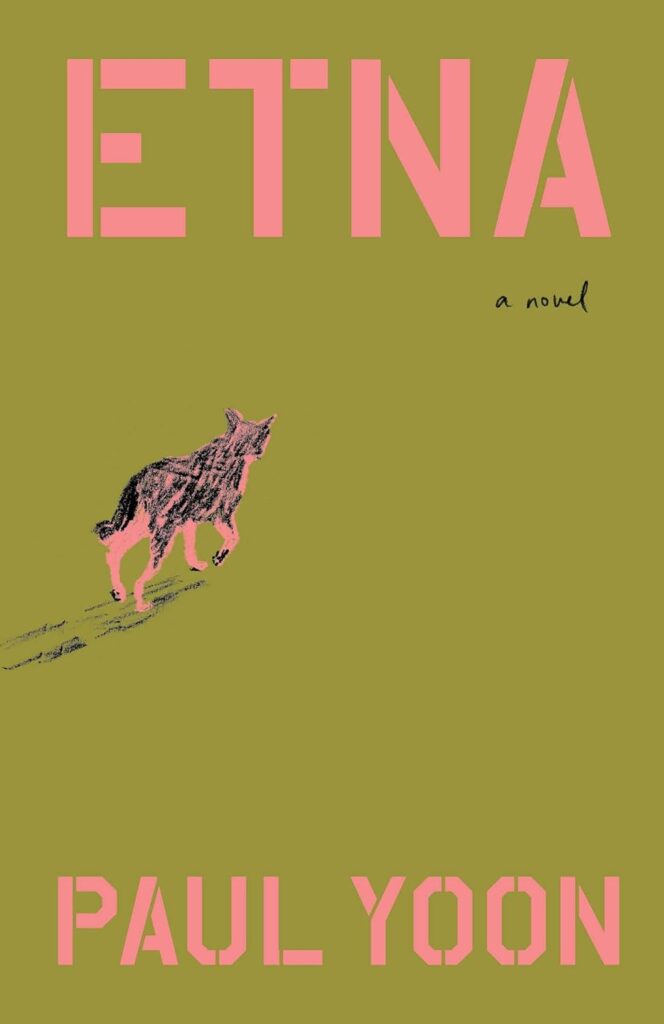
Etna
Paul Yoon
Scribner, August 4, 2026
Etna, by Paul Yoon, is about a young farm dog conscripted into an unnamed war in an unnamed country. Yoon’s writing style is both simple and powerful. It is Etna who narrates the story, and the success of the novel rests in the reader’s ability to believe its canine voice.
From the novel’s very first page, Etna’s voice is poetic. When he details his emotions soon after being taken from his home, Yoon reminds us of Etna’s human qualities:
I was born near water. …My mother was there. My brothers and my sisters. An early memory: waking up to a den of pale noses surrounding me before our mother came, the silhouette of her face looming over us in the sky, the tall triangles of her ears pocketing the smell of the coast.
Having been taken from his coastal farm home and trained to detect explosives, Etna “speaks” about the rigorous training and heartbreaking losses endured by both canine and military troops required in war. Etna doesn’t understand political causes or military strategy; he knows loyalty, fear, pain, and survival. This simplicity renders the violence and chaos particularly moving. Yoon spares the reader from war’s graphic horrors, relying instead on quiet details and subtle observations to communicate its effects.
The battles end, and a physically scarred Etna, whose fate is unclear since he is believed to no longer be of use to the military, leaves camp and sets out across the ravaged landscape to find his way back home. As he travels to find his way “home,” he continually uncovers the devastation war leaves behind.
Although Etna’s story is ultimately about finding home, his journey is more than an attempt to return to a physical place. It is about the peace and sense of belonging he lost.
Etna is a beautifully written and deeply moving work of literary fiction that examines the cost of war while redefining the true meaning of home.
Perhaps a lesson for us all.